Showing posts with label Tour in Vietnam. Show all posts

Thursday, May 02, 2013

Vietnam welcomes waves of Russian tourists

While the number of tourists from other European countries has been on a decline, common tourism spots around Vietnam are being flooded by Russian holidaymakers.
A Russian tourist is seen shopping at Nha Trang Center in Nha Trang April 29, 2013
Around 130,550 Russian tourists visited Mui Ne last year, accounting for 36.7 percent of the total number of foreign holidaymakers, according to Binh Thuan Province’s tourism department.
“People usually think Russian tourists tend to practice thrift during their tours, but they in fact can spend up to VND2 million a day, so long as the services are of good quality,” said Nguyen Quoc Khanh, owner of a restaurant at Mui Ne, where groups of Russian-speaking travelers were spotted on April 30.
There are so many Russians in the area that many restaurants, ticket agents, cafés, and massage parlors have their menus written in Russian, Khanh said.
Mui Ne has emerged as a peaceful and low-cost relaxing destination for Russian holidaymakers, according to Alexandre and his wife, Cawa, a couple from Irkutsk.
Ton That Hung, who works at Coco Café, a tour organizer, said Russians account for nearly 30 percent of the company’s total customers.
Meanwhile, Tran Anh Thi, managing director of Seahorse hotel, said 45 percent of the facility’s current customers are Russian.
“However, while Russian tourists want to enjoy more than just beach bathing and eating seafood, local services fail to meet their demand,” he noted.
1,000 arrivals per day
Similarly, Russian tourists also flood foreigners’ quarters in Nha Trang these days.
Ngo Vo Bach Viet, head of the Nha Trang representative office of Anh Duong Travel Co, said his company is bringing some 1,000 Russian tourists to the coastal city on a daily basis via 19 direct flights between the area and 22 cities in the Eurasian country.
Russian travelers topped the list of foreign tourists to Nha Trang over the last two years, according to Khanh Hoa Province’s tourism department. The coastal city welcomed around 100,000 Russian tourists last year, the department said.
“There are three to five Russian tourism delegations, or 300 tourists, shopping at Nha Trang Center everyday,” said Nguyen Thi Gia Thao, chief of human resources of the commercial center.
Russian holidaymakers account for 70 percent of total foreign customers, and 50 percent of the total revenues, according to Nguyen Huu Nghia, deputy CEO of the Hoan Cau Khanh Hoa Co Ltd, the operator of the shopping center.
More Russian-speaking tour guides
Although the number of Russian tourists to Vietnam has constantly risen, the figure is still modest compared to the 45 million exits from Russia for overseas holiday every year, according to tourism experts.
Vietnam thus has to continue to boost the tourism promotion to lure more customers, and investing more on the training of Russian-speaking tour guides, they said.
The Ministry of Culture, Sports, and Tourism has recently approved a VND6.3 billion program for Khanh Hoa to have a well-trained force of Russian-speaking tour guides.
“Russian tourists will be the main market of Nha Trang in the future, and we are considering organizing new cultural activities and increasing the quality of local services to serve them,” said Truong Dang Tuyen, director of Khanh Hoa Department of Culture, Sports, and Tourism.

Source: tuoitrenews.vn

Friday, December 23, 2011

HCMC aims to protect tourists from robberies

Group of security guards help foreign tourists cross the street in Ho Chi Minh City
Ho Chi Minh City authorities are deploying measures to protect tourists in response to the increasing number of robberies aimed at foreigners in the city.
Last Friday afternoon, Trung Hieu, a security guard at Ben Thanh market’s East gate heard two tourists shouting “Robbers, robbers” from a distance.

On arriving at the scene, he found a Japanese woman in her 20s panicking, crying on her boyfriend’s shoulder.

Hieu and his colleagues quickly followed two bag snatchers riding a Dream bike towards Le Loi Street.

Stopped by locals at the Le Loi- Nguyen Trung Truc intersection, the thieves threw their bike down and ran away.

However, they were soon seized by Hieu and his colleagues.

After getting back the stolen iPhone, the Japanese tourists were happy and kept on saying thanks, Hieu recalled.

Tran Duy Phong, who serves as a security guard for the city’s Voluntary Youth League, said robberies in Ho Chi Minh City have recently become complicated. His team’s duty is to ensure safety, help tourists cross the street, prevent them from being disturbed by hawkers, and keep them alert of street robbers.

“When we see tourists exposing a bag or backpack, camera, or phone in an unsafe way, we will advise them to keep it closer to them to prevent robbery. Also, when spot tourists acting as if they are unsure of something, we inquire and help them to find a solution,” he said.

Phong recalled one day when he was patrolling around the De Tham and Bui Vien intersection, in District 1, when he saw a young man riding an Air Blade grab a female Canadian tourist’s purse. Immediately, he and two colleagues ran after the robber.

An electrician working nearby used a wooden ladder to block the way, causing the thief to fall off his bike. He quickly got up and ran away.

But after being chased to a dead end, the thief started to act innocent.

“I didn’t do anything, why did you follow me?” he asked the guards.

However, the tourist’s wallet in his pants pocket told the story. The thief was soon taken to the Ben Thanh ward police station.

According to Phong, guards from the city’s Voluntary Youth League go on shifts to ensure security for tourists visiting Ho Chi Minh City. Although they have limited English proficiency, these young guards can still carry on basic conversations with tourists.

“The end of the year and the Tet holiday are prime times for thievery around the Ben Thanh market; we cannot be inattentive,” Phong warned.

Recently, many local netizens have spread the story of Doris and Kay, two tourists from Hong Kong who had to sell their own pictures in the city’s Pham Ngu Lao backpacker area after being robbed of all their possessions, including passports, last Thursday.

While sitting on the back of a bike, Doris had carefully put her bag between her and the driver. However, the thief still managed to snatch it and get away.

“Thieves are present in every country, but it was the first time I’ve seen someone riding a scooter and robbing bag at the same time. This is a lesson for me if I return to Vietnam,” said Kay, Doris’s boyfriend.

Nguyen Viet Anh, head of the Travel Division of the city's Department of Culture, Sports, and Tourism, told newswire VnExpress that robberies targeting foreigners in the city happen frequently and are on the rise.

“We held a meeting with the city’s People Committees and related departments to find solutions to reduce robberies in the city,” he said.

The department will cooperate with local police and tighten security and patrol forces to protect tourists from theft.

It also demands that restaurants, hotels, and travel agencies in tourist areas equip travelers with information on how to take care of their belongings, as well as how to deal with robberies.

“Tour guides should know hotlines to call security guards in the area or local police so that they can find a quick solution for robbed tourists,” he said.
Source tuoitrenews.vn

Friday, December 16, 2011

Hong Kong tourists say robbed, sell photos for food

Two tourists from Hong Kong are selling their own pictures on the street in downtown Ho Chi Minh City to be able to get their daily meals.
They claim they were robbed of all their possessions and identity papers by bag-snatchers on a scooter.
Their story and photographs, posted on a blog on Wednesday, have spread rapidly and attracted sympathy from many netizens.
Doris and Kay say they lost their bag with their cash, credit cards and identity papers while walking on Xo Viet Nghe Tinh Street in Binh Thanh District.
Doris and Kay sell their own photos on Ho Chi Minh City’s Bui Vien Street
after being robbed off all their possessions, including identity papers
After reporting the robbery to the local police and getting an appointment for a week later to see if they could retrieve their belongings, the duo went to District 1’s Bui Vien Street – known as the city’s backpacker’s area – to sell photos for food.
On a piece of cardboard, they wrote: “All robbed, pls support.” And a piece of paper carries information about their loss in Vietnamese, asking people with any information to call 0908.012123.
On another piece of cardboard, they warn others to be careful. “We are from Hong Kong. Just watch out professional scooter robbery! Kay and Doris.”
Within 24 hours after their story was first posted on a blog, many netizens have shown their sympathy and expressed their readiness to support them.
Blogger Poly said the duo had planned to spend Christmas and the New Year Day in Vietnam. They are waiting to obtain a new passport from the Consulate General and are having to sell their own photos to survive.
“Doris is a woman and she should not sit on a HCMC street all day in changing weather. We should know why Doris is crying. What would they say when they get back to their own country?” the blogger wrote.
Many others have offered to host the duo in their homes and said they are furious with the robbers who give the city a bad name.
Thanh Nien Weekly was not able to reach the Pham Ngu Lao Police Station for comment despite several calls.
A shop owner on Bui Vien Street told Thanh Nien Weekly on Thursday that the duo were selling their photos on Wednesday evening and a resident on the street let them stay in their house later.

Saturday, December 10, 2011

4,000 years old but still in working order

Quang Tri Province’s best known tourist attractions are DMZ tours, Cam Lo Market, and relics of an uprising led by a man who was crowned as King Ham Nghi in 1885, becoming the eighth emperor of the Nguyen Dynasty.
But the north central province also has some lesser known gems to offer to visitors, one of them being a network of wells that is said to be 4,000 years old.
The wells belong to the Neolithic period when wet rice cultivation was practiced.
During a recent visit to Hao Son Village in Gio Linh District, we saw the network of 14 shallow wells that the Ministry of Culture and Information recognized as “the nation’s historic and cultural relic” in the early 1980s.
The wells are only about 20km northwest of the town of Dong Ha, and visitors can reach the place by car.
Canal carrying water from one of the ancient wells to farms in Gio Linh District
Professor Bui Huy Dap, who has researched wet rice farming civilization and rice farming in Vietnam for more than 30 years, said the system of irrigation in Gio Linh was built in the late Neolithic period.
“It is a sophisticated system that ensured water flowed automatically,” he said.
“In the higher place is a large flat area used for collecting water. Then, there is a reservoir collecting water flowing from the higher place.
“The second reservoir, which is lower, collects water from the higher reservoir which runs down through a system of bamboo tubes. And the lowest part is a large pond with canals carrying water to the farms.
A revolution during the Neolithic era in Vietnam promoted the development of rice farming and innovations in water use.
Tran Thi Quynh Nga, a local socio-cultural official, said: “The wells today are perhaps shallower than they used to be, but the water is still clear, and we can see small crabs at the bottom.”
Children from the village come and bathe in the wells.

HOW TO GET THERE
From Dong Ha Town, go north for 10 kilometers to reach Gio Linh District. Then go west for another 10 kilometers to reach Gio An, the site of the 4,000-year-old wells.
Visitors can take a taxi or book a tour at Huong Giang Tourist Co. in Hue, Quang Tri Tourist Co. in Quang Tri, or Vitours in Da Nang. These companies provide cars and guides for visitors to see the ancient wells and go on DMZ (demilitarized zone) tours.
Sandstones are piled up around their edges, and sandstone-lined canals connect the wells to farms where watercress is grown. The wells are situated at different levels and a dozen meters apart. Water keeps oozing out of cracks in the rock.
The villagers say the water is cool in summer and warm in winter. They used it not only for washing and irrigating, but also for drinking.
“Bamboo tubes are no longer used for carrying water. The water flows from one well to another and on to the farms along the canals,” Nga said.
By Truong Dien Thang, Thanh Nien News (The story can be found in the December 2nd issue of our print edition, Thanh Nien Weekly)  

Friday, November 11, 2011

Vietnam and the Philippines united by nature

Halong Bay consists of more than 3,000 limestone islands rising spectacularly from the ocean
Vietnam's Halong Bay consists of more than 3,000 limestone islands rising spectacularly from the ocean
The Philippines and Vietnam have agreed to support each other in the New7Wonders of Nature campaign. The decision was reached at the East Asia Inter-Regional Tourism Forum (Eatof) standing committee meeting yesterday in Cebu City.
The commitment to support the Puerto Princesa Subterranean River in the Philippines and Vietnam’s Halong Bay was part of the joint declaration of the Eatof, which was presented at the Cebu International Convention Center.
Cebu Vice Governor Agnes Magpale, who presided over the meeting, said it does not matter how the two destinations will be ranked, provided they gain enough support to be included in the New7Wonders of Nature.
Eatof seeks to promote tourism in 12 Asian provinces, including Cebu and Quang Ninh Province in Vietnam, where Halong Bay is located. Vu Thi Thu Thuy, vice chairperson of the Provincial People’s Committee in Vietnam, said there is no contest between Halong and the Subterranean River as Eatof will support both.
“It’s a win-win game for the strength of Eatof,” Thuy said.
The Puerto Princesa Subterranean River  winds through a cave before flowing into the South China Sea
The Puerto Princesa Subterranean River winds through a cave before flowing into the South China Sea 
Source: http://news.n7w.com

Monday, May 16, 2011

HCMC taxi overcharges foreigners by 40 times


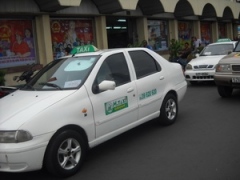
A Mai Linh taxi (for illustration purposes only)

Three Malaysians have fallen victim to a Mai Linh taxi scam in Ho Chi Minh City, paying VND6 million (US$300) for a ride that should have been VND150,000 (US$7.50).
One of the customers, Nasiniya Mohd Taib, said she and two friends took a taxi with a Mai Linh Taxi Group logo and the phone number 0839620620 on the side of the car from Ben Thanh Market to Tan Son Nhat Airport on the morning of May 10.
Upon arriving at the airport, the taxi driver charged them VND4 million (US$200) and 300 Malaysian ringgit (US$100), overcharging them by VND5.8 million ($US285).
Nguyen Tuan Sinh, head of Mai Linh Taxi Group’s labor union, said he went to Ben Thanh Market after the incident was reported to him and found the car was a scam taxi operating under Mai Linh’s name.
When Sinh and his officers found the car, which has license plate number 52V-0160, they tried to take photos but the driver attacked them.
Nguyen Ngoc Hieu, head of Mai Linh Taxi Group’s subsidiary Communist Party Committee, said taxi scams are not new and there have been numerous cases where drivers use the Mai Linh name to trick customers.
A representative for Mai Linh said scam taxi’s using Mai Linh’s name usually frequent Ben Thanh Market, Bach Dang Port and the Saigon Notre-Dame Cathedral.
Mai Linh said they have asked the authorities for a solution, but the scam taxis still exist.
The company advised its customers to pay close attention to the driver’s uniform, the logo and the phone number on the cab in order to avoid the ploy.
Recently, there have been an increasing number of scam taxis in HCMC reported by foreign customers.
tuoitrenews.vn

Monday, April 25, 2011

Nha Trang hotel catches fire, guests saved

No one was hurt when a fire broke out at the 15-storey Asia Paradise Hotel in Nha Trang City, Khanh Hoa Province at 7pm yesterday.
71 guests were staying at the hotel when the fire broke out in the basement.
The municipal firefighters had to break some glass doors of the hotel in their effort to extinguish the fire.
Police and health workers arrived in time to take all of the guests to safety.
The fire was put out after two hours.
Colonel Dang Van Manh, deputy head of the Khanh Hoa Province Police Department said the police are investigating the cause of the situation.
tuoitrenews
 

Thursday, April 21, 2011

Vietnam’s best beaches

Vietnam might have been late to Southeast Asia’s beach party, but it was worth the wait.
Take a spin along the long luscious stretch of sand at
Cua Dai beach in Hoi An. (Bernard Napthine/LPI)
The country has more than 3,400km of coastline, with infinite stretches of powdery sand, hidden coves, lovely lagoons, impossible boulder formations and tropical islands ringed with yet more beaches. Help! Too many choices!
Nha Trang
The heavyweight champion of Vietnam, Nha Trang has been knocking out visitors for years. True, the town is brazen and brash, but the beach is bold and beautiful and a gateway to a cluster of quieter islands.
Mui Ne
Set on a seductive swathe of sand, Mui Ne is an absolute charmer with swaying palms and towering dunes. Get pummelled on the beach by a masseur or pummelled by the waves with some water sports - this place blends action and inertia to perfection.
Phu Quoc
Simply the most beautiful island in Vietnam, Phu Quoc is liberally sprinkled with picture-perfect white-sand beaches and cloaked in dense, impenetrable jungle. Long Beach is sophisticated, Ong Lan Beach is romantic, and Bai Sao is simply irresistible.
China beach
OK, so we are using artistic licence with the name, but whether you call it My Khe to the north or Cua Dai to the south, it is all just one long, luscious stretch of sand. Try surfing off the shores of Danang or just pamper yourself at the resorts near Hoi An.
Con Dao
The Con Dao Islands have been protected from over-exposure by their isolated location off the coast. Enjoy it while it lasts, with their smattering of resorts and an overdose of idyllic beaches, as this is sure to be the next big thing in Vietnamese beaches.
Doc Let
While the rest of the world is sunning itself in Nha Trang, slip up the coast to this little teaser, home to some atmospheric resorts and some squeaky white sand; a place to get away from it all.
Ho Coc
Vung Tau to Phan Thiet is almost one long beach, but much of it remains mercifully inaccessible to the masses. Sample its potential with a retreat to Ho Coc, a glorious sandbar about midway along this stretch.
Source BBC

Wednesday, April 20, 2011

Shemales offer sex to steal from HCMC foreigners

Two shemales offer sex to a foreigner at the 23-9 Park in District 1, HCMC
A phenomenon in which trans-sexual ‘girls’ lured foreigners to hotel rooms to have sex and then stole their assets has recently been reported in Ho Chi Minh City, especially in District 1 – the backpacker’s area.

* It is hard to identify them as trans-sexual girls as they look feminine and nice
* Shemales usually steal from foreign men when they are bathing in hotel rooms.
* Some foreigners lost all money and had to withdraw money from ATMs to pay for taxis
* There are organized rings of shemales in District 1.

Those shemales target foreign men who wander on streets alone at night. Those men are called by shemales as “Tay mo coi” (“orphaned foreigners).

Every night, shemales travel about the city downtown on luxury scooters to hunt for “preys”.

Accompanying some District 1’s criminal policemen on the night of April 8, Tuoi Tre reporters found many nice trans-sexual girls traveling around many streets in the district like Tran Hung Dao, Le Lai, and Nguyen Thai Hoc to search for “orphaned foreigners.”

At first sight, nobody could know such girls were actually young men who have undergone sex change surgeries, as most of them are beautiful and charming.

At 23:50 p.m. , we saw two “girls” stop their deluxe scooter in a corner of the crossroads of Nguyen Thai Hoc – Pham Ngu Lao Streets. One of them got off the bike and came over to a foreign pedestrian, may be a South Korean.

After a few minutes talking with the girl, the man went away, but the girls still followed him to Bui Vien Street. The two sides continued negotiating and then the man got in a taxi with one of the shemales.

The taxi ran towards Chu Y Bridge and then turned right to Pham The Hien Street in District 8. When reaching near the Mat Bridge, the taxi suddenly turned back and ran to the foot of the Chu Y Bridge and stopped.

The girls rushed out of the taxi and went away to the surprise of the foreign man.
It seemed that the girls could have found something unsafe or had some argument with the man.

Offer sex to steal assets

Earlier, on March 19, at the 23-9 Park, near New World Hotel in District 1, we witnessed two shemales coaxing two Japanese men into spending a night with them.

After no more than 1 minute of bargaining, the men agreed to go with the beauties, who drove them on their Attila to a hotel on Hung Vuong in District 10.

Only ten minutes later, the two shemales hurriedly get out of the hotel and drove away in two different directions.
  The two Japanese rushed out of the hotel a few minutes later, looking around with anger. They then asked hotel staffs and motorbike taxi drivers nearby about the two girls. Eventual, they could do nothing other than take a taxi to return to New World Hotel.

On the way to the hotel, the taxi had to stop at an ATM box on Nguyen Trai Street for the guests to withdraw money.

Tuoi Tre reporters came and asked them what had happened to them, but the Japanese men embarrassedly said they did not want to report the problem to police.

On February 24, two other Japanese young men were driven by two pretty shemales and a Vietnamese man from Le Lai Street in District 1 to a hotel in District 10.

Similarly, the girls and the local man left the hotel only after 15 minutes. One of the Japanese men later reported to the police of Ben Thanh ward, where they registered for temporary residence.

He said the two ‘girls’ lured him and his friend to go for a message at a price of VND400,000/person.

Once in a hotel room, the girl asked him to take off his clothes and lie on his belly on the bed. While ‘she’ was massaging him, he [with his face down] had a feeling that some other people secretly entered the room but he could not turn over as she was weighing down on him.

After the massage ended, he discovered he lost VND4 million (US$195). The girl was nowhere to be found.

After looking at a number of photos of shemales provided by the police, he identified the ‘girl’ who had been with him in the hotel room.

The girl is actually a young man, Nguyen Minh Tri, 18, who has undergone a sex change surgery and is now living in District 8.

Two criminal shemales rings

There are two gangs of trans-sexual women who conducted crimes in District 1., said the district police department.

One of the two gangs is led by a shemales named G.K., coming from the underground world in District 8, according to police.

The gang operates in the areas on Pham Ngu Lao and Le Lai streets, District 1, where many foreigners live in hotels.

The gang members usually lured their “preys” to hotels in other districts for sex or massage and then stole their money while they were in the bathroom or sleeping.

The thieves would manage to hand over the stolen money to ‘her’ mates waiting outside the room.

The other gang is also headed by trans-sexual women, Men, and operates mainly in the Da Kao ward area with similar tricks.

The fact that the gangs took their guests to different hotels in different districts causes a lot of difficulties to relevant agencies in catching them, said police.

In addition, the gangs are also helped by a number of motorbike taxi drivers, who would drive the thieves away on their motorbikes after each accomplished mission.
tuoitrenews

Friday, April 15, 2011

Don't judge VN tourism from your own experience

Over the last few days the more I thought about the article “What’s wrong with tourism in Vietnam?”, the more it annoyed me.

Not everyone sees the world through American eyes. “Vietnamese are like Australians and perhaps find serving people demeaning or beneath them”- what a ludicrous statement. Perhaps it’s more the case that both nationalities see it as shallow to greet every customer with “Hello, how are you, how can I help you today” and “Enjoy your meal, have a good day” and saying these things as some automaton gesture renders them meaningless.
Of course you find good and bad in Vietnam- are there not rip-offs in every country? Restaurants are welcome to sell seafood at any price they like at Ha Long bay. It’s a free economy. And you are free to choose cheese if you wish- but I wager you're missing out on a great experience.

Bad hotel experiences? I stayed in a hotel in Rodeo Drive (Beverly Hills, California) once and during the night the plumbing ruptured so that most of the rooms had no shower or water. The guests all lined up to check out the next morning, hot and sticky in the California summer and there was no offer of a discount or anything other than a lame apology for the inconvenience. I am Australian so I didn’t make a fuss. I certainly didn’t judge the American tourism industry based on this experience.

I see the statistics of ‘repeat visitors’ comparing Thailand and Vietnam all the time. I simply don’t believe these claims. For a start Thailand does ask if the visitor has had a prior trip to the county on the arrival card. Vietnam does not. Good or bad I don’t believe Vietnam has a method of measuring repeat visitors to the country. Tracking passports isn’t a reliable method as people renew these every 10 years or so.

Secondly Bangkok is a major international hub, Saigon is not. Many travelers take in a few days shopping in Bangkok, or some days at the beach on the way elsewhere. Also whilst Vietnam is an amazing country, with so many countries to visit in the world- whose notion is it that people should return visit? Yes I agree that some of the cement structures in Vietnam are on the ugly side, but the more they build in a modern aesthetic, the less Vietnam looks like Vietnam and the more the place looks like, well, Darling Harbour in Sydney!

Tourists, even on tour with a tour-guide as adults can surely solve the occasional language problem when ordering eggs and coffee. A tour-guide is a tour-guide, not loco-parentus. For sure some tour-guides could work harder for their living, and show more concern for their clients. The same could be said for American bankers.

In Vietnam’s defence- the country does have something that the world has lost. It’s called ‘a sense of community’. Vietnam isn’t only a collection of scenic locations, it’s a culture of people connected and unified in an unusual way, with values, history and behaviours different to any culture. If you’re on about concrete, war memorials, rural vistas and the price of seafood you’re missing the point. Vietnam has very low crime rates, the country is very safe compared to western standards. Vietnam has very low rates of homeless people, you hardly ever see people living on the streets, unlike the country that prides itself in having the world’s largest economy. No old person dies in house in Vietnam and lies undiscovered for days or weeks.

Having grown up in Australia, I barely recognize the place anymore. Everything is illegal. Arrive with a baby or two infants at the airport and no taxi has the child restraints to transport you and any driver is terrified of a AU$300; 3 demerit point fine. Hotels have ‘no eating sections’ – where it’s illegal to eat food (the smoking section)- I’d like to sit on the veranda in the sun and eat my meal; “sorry sir that’s illegal”. On any occasion some teenager has a fatal car accident there are calls from the community to make it harder for ALL YOUNG DRIVERS- even the majority that seem to avoid participating in a fatal car accident and simply wish to drive home from their supermarket night-fill job.

Personally l love Vietnam just as it is. If I could stop the country progressing further into the 20th century, I would. I like the place being in the 12th century, or 16th century. The food is fresher, the people friendlier, the traffic lighter and you feel like you’re part of a community. Vietnam is rich in ways that western countries are poor- the tragedy is- the Vietnamese don't know this fact. Vietnam is more enjoyable when you take it as it is, rather than experience it though a filter ‘how you think it should be’.

Finally I’d like to add a true story I published some time back in the Live Hoi An Magazine. It illustrates two worlds with very little understanding between them:

A few years ago I was sitting enjoying breakfast at the Cargo club. A tall young American stood in the doorway watching the rain pour down outside. The young waitress started a conversation- “Where you from?” “I’m from New York” he replied. “How long are you travelling?” “I’m travelling for three months and I’m going to Thailand, Laos, Vietnam and Cambodia… Have you ever travelled?” The waitress answered in a shy voice “No.. I’ve never travelled but I’d like to”. The American asked- “Where would you like to travel to?” The waitress answered in an embarrassed way “I’d like to go to Dalat.”

At this point, I should explain that every Vietnamese girl wants to go to Dalat. Dalat is the honeymoon town. Vietnamese girls don’t dream about corporate ladders- their dream is to find a nice boy, get married, and have a romantic honeymoon in Dalat. So, surprised by her answer, the American says “Dallas? You’d like to go to Dallas?” The waitress said shyly “Yes I’d love to go to Dalat”. “Do you know anyone in Dallas?” the boy asks. “No… I just want to go there one day, I’ve always wanted to go there”. I enjoyed the poached eggs that morning at Cargo, watching the rain, and listening to an American boy and a Vietnamese girl share the same ten minute conversation about Dalat and Dallas, two entirely different cities!
Phil Mellifont (Australian, living in Hoi An, Vietnam)- Tuoitrenews

Wednesday, April 06, 2011

Is good money being thrown after bad?

Despite hundreds of thousands US dollars invested to have its tourism publicity broadcast on CNN, BBC and even in London cabs, Vietnam’s “hidden charm” still remains unrevealed.
Vietnam is becoming keen about spreading the message it is an attractive tourism destination but there are no results yet to show for it.
The government has spent hundreds of thousands of dollars on commercials that air for just a few seconds on international channels like BBC and CNN.
In just the second half of last year, it forked out VND5.3 billion (US$253,600) to CNN, or 12 percent of the total tourism promotion for the year.
An online survey by the Vietnam Economic Forum of 200 tourists from around the world found that 77 percent had never heard or seen about Vietnam on the media or at tourism fairs.
There was also a six-month ad campaign ran on 27 out of London’s 10,000 taxis, but many locals say they have not seen it.
Vu Huy Vu, deputy chairman of Saigon Tourist, says however that in recent times the Vietnam National Administration of Tourism has spent heavily to spread the word about Vietnam to the world and achieved positive results.
Proof of it is the increase in foreign arrivals despite the economic recession, he says.
But he emphasizes the need of establish travel agencies in other countries to consistently spread the word rather than occasionally attending tourism fairs.
“It cannot be done overnight; we must keep at it,” he says.
“Our regional competitors like Thailand, Singapore, Philippines, and Indonesia have a huge budget for tourism development.
“They set up travel agencies in potential markets like Europe and America not two or three years ago but a decade ago.”
Financial and human-resource constraints admittedly hinder Vietnam’s efforts to boost its tourism industry, but an effective and cheap channel – the Internet – has not been adequately used.
Ben Chua, the Singaporean founder and administrator of the website vietnam720.com, uses interactive features like video, audio, and animation to describe Vietnam’s tourist destinations to the world.
“The website provides an interactive tour, which allows visitors to have a view of their desired destination,” he explains.
“Just go to the Singaporean tourism website (yoursingapore.com) and you will find everything about this country. For instance, the keyword ‘art’ will show you every single piece of information related to art in Singapore.”
He also mentions his Twitter account, which he created to collect people’s opinions and comments about Vietnam. There is one new “tweet” every 10 seconds, meaning 36,000 comments or opinions per hour.
It is a goldmine of information but the government has shown no response on it so far.
“How come such a rich source of what foreign tourists like and dislike about Vietnam receives no attention from the government?”
Which image for Vietnam?
In January the Vietnam National Administration of Tourism gave away the first prize to a contestant who suggested “Vietnam – a Different Orient” in a slogan-logo contest.
But two months later it remains unapproved and the tourism industry still cannot start its marketing campaign for this year.
Foreign visitors seemingly continue to see Vietnam as a heroic country which won wars rather than as an appealing destination for travel.
“Vietnam is a friendly and joyful country but the country image that is displayed to the world just fails to show this,” Tim Russell, chairman of the travel agency Come & Go Vietnam, says.
Russell, who has been working for long in Vietnam, also emphasizes the fact that Vietnam does not enjoy a reputation as a “joyful destination” meaning only 5 percent of foreign tourists return to the country after their first visit.
This figure is 50 percent for Thailand.
Vietnam has been able to appeal only to visitors who are keen on culture and discovery, he says, but travel is not just about discovery.
It encompasses a great variety of things like leisure, golfing, beach sports, food, and nightlife, and without these, Vietnam cannot attract true holidaymakers, those who contribute to the development of the country’s tourism, he warns.
Thailand is famous for its lively nightlife, golf clubs, and beaches; while Singapore is renowned for its attractions and shopping places.
“Both of the countries have these featured advertised with their cultural values,” Russell explains.
Vietnam should hire a professional consultant and do more surveys of tourists to have an effective marketing campaign, he adds.
Nguyen Van Tuan, director of the Vietnam National Administration of Tourism, also suggests that the government should allow the hiring of a foreign consultancy and experts.
“Actually, we are now sponsored by some international tourism associations like JATA (Japan) and countries,” he says.
He lists three key points for the promotion campaign in the coming years: making tourism a key sector; intensively developing tourism with a brand name; and boosting tourism along with security and sustainable development.
tuoitrenews

Thursday, March 17, 2011

The good news gongs


The sounds of a young cong chieng(gong) band in Kong Chro Commune have inspired amateur listeners and long-time lovers of the music alike.
Dinh Keo’s efforts in teaching youth in Gia Lai
Province to play the gong is helping to preserve
this unique aspect of Central Highlands’ culture
The 30 children have blown new life into the nation’s antique art and drawn listeners to their small corner in Gia Lai Province.
Throughout the Central Highlands of Vietnam, gong ensembles have traditionally participated in ceremonies tied to the daily lives of the region’s diverse ethnic communities. The musical styles are, in no way, alike. Ritual functions, genres and techniques vary widely.
In most of these communities, however, these instruments (wrought from bronze and silver) are regarded as a divine medium—capable of bridging the gap between humanity and the supernatural world.
“The gong plays an integral role in the culture of the ethnic people of Gia Lai Province,” said Phan Xuan Vu, manager of Gia Lai Province’s Department of Culture, Sports and Tourism. “The instrument’s unique cultural legacy dates back hundreds of years but it has been strongly affected by modernization.”
According to Vu, the gongs traditionally played a central role in the indigenous religious ceremonies of various small rural communities. As those communities move further into mainstream Vietnamese society, their ancient beliefs, practices and instruments are often left behind.
Some, however, are holding out. In the remote and impoverished village of Kong Chro, Dinh Keo, an aging gong artisan, is doing his best to train a whole new generation of musicians.
In 2006, a five-year-old boy named Pram wandered into Keo’s workshop.
The boy seemed more interested in his instruments than playing out in the midday heat. So Keo began to teach him how to properly strike the instrument.
More children began showing up to his workshop, hoping to learn now to play the instruments. Keo said that the idea of gathering a gong class for children splashed through his mind when he noticed that the traditional, handmade instruments were being sold and stolen throughout the impoverished community.
With help of the village patriarchs, Keo began training these little students. Pram remains his youngest apprentice – to this day, he can only handle the smallest gong (around 25 centimeters).
“You must be patient and encourage them to understand and have a passion for the gongs,” Keo said. “It takes a lot of time and effort to work with the kids, aged five to six. Their mothers helped a lot when they spent nearly a month weaving beautiful costumes for their kids to wear in competition.”
More and more little students began flooding into the class. Soon enough, Keo formed a band.
In 2009, the tiny gong team arrived at the first-ever International Gong Festival in Pleiku dressed in matching multi-colored cuffs and red patches.
The team won praise from both local and foreign tourists for their soaring performances.
After just one year, Keo’s gong team, aged 10-14, could confidently participate in any cultural festival, throughout the country. What’s more, a group of female singers has been formed in the village to accompany the band.
Keo said he is satisfied with this new generation of traditional artists.
He worries, however, about the fate of the aging generation of gong makers. So far parents have relied solely on him for his expertise and advice.
“Now we must rely on the kids, for they are both the origin and the future,” Keo said. “Faced with the possibility of losing a cultural asset, the children will be great warriors – they have not been absorbed into foreign culture.”
Keo has worked hard to spread his mastery of the instrument.
After years of training Dinh Glich and Dinh Chrum in the art of gong making, the men frequently return from their neighboring communes to help teach his classes.
Keo says that his greatest wish is to found more and more young gong groups in the Central Highlands. He says he’s willing to go anywhere to help make it happen.

Tourists could see Southeast Asia on single visa


Travellers could soon be able surf in Bali, shop in Singapore and eat spicy street food in Thailand before crossing into Cambodia and cruising the Mekong in Vietnam – all on a single tourist visa.
Boats in Ha Long Bay, a famous tourist spot in Vietnam
The Association of Southeast Asian Nations (ASEAN) is working on a plan that would open the region to foreign tourists in the same way Europe's unified visa system has streamlined travel.
"You would just have to apply for one visa and you could then visit all the countries using that visa," said Eddy Krisneidi, an official at the Jakarta-based ASEAN Secretariat, which recently released its Tourism Strategic Plan for the next five years.
With attractions ranging from jungle-covered temples at Angkor Wat in Cambodia to five-star beach resorts in Bali, Southeast Asia is a region that tempts travellers from all walks of life.
ASEAN countries recorded more than 65 million foreign visitor arrivals in 2009. Malaysia led the field, followed by Thailand, Singapore, Indonesia, Vietnam, the Philippines, Cambodia, Laos, Myanmar and Brunei.
Analysts say visitor numbers could be boosted by slashing the time-consuming and confusing visa requirements for each of ASEAN's 10 countries.
While some allow foreigners to simply purchase visas on arrival, others require wads of paperwork, photos and up to a week to issue the required stamp.
"One of the major concerns of the industry, as well as visitors, is the difficulty of obtaining visas, a series of widely differing regulations and information needs for visas," ASEAN's strategic plan states.
It is a view shared by Stuart McDonald, who runs an online travel forum for Southeast Asia.
"One of the most common questions that we see on travelfish.org is people asking visa questions: What kind of visa can I get? How long is it valid for? What does it cost?," said the Australian who travels extensively in Asia.
"The rules change all the time and it introduces a level of uncertainty and confusion that the industry can do without."
The concept of a single visa has wide support among tourism bodies across Southeast Asia.
"It would definitely benefit all the countries in this region, especially Thailand," Tourism Authority of Thailand governor Suraphon Svetasreni said, noting that Thailand is a "good strategic location" for overland travelling as it acts as a bridge to other countries.
Svetasreni said it is only a matter of time until the region's visa system is liberalised.
"ASEAN will be considered as a single destination, so it makes sense to apply for a single visa to travel to any country in ASEAN," he said.
Despite its appeal, others are less optimistic that a single visa will become a reality anytime soon.
"Travel procedures have to be simplified but it is not going to be easy because each country may have their own foreign policy," Malaysian Association of Tour and Travel inbound tourism vice president Arul Das said.
ASEAN is yet to outline the cost or length of stay for its planned single tourist visa. But it acknowledges it could take several years to introduce.
"The establishment of such a visa will not likely occur in the next five years due to barriers of technology, political issues, concerns of sovereignty and security and the different visa systems in the member states," its strategic plan states.
The single visa is one of several initiatives being worked on by ASEAN to boost tourism in the region.
The organization is also overseeing the creation of regional tourism standards which would apply to things such as accommodation, food and public toilets.
"There are already clear indications that major tour operators are now very much concerned with a wide range of standards in a destination," the plan states.
"Those destinations that are able to satisfy those increasingly high standards will have a distinct position of advantage."

$30,000 raised from the Saigon Cyclo Challenge 2011

Participants are racing around the Crescent Lake
in District 7 in Ho Chi Minh City on Saturday
The annual charity race named Saigon Cyclo Challenge 2011 took place in Ho Chi Minh City’s District 7 on Saturday with its organizer – the Saigon Children’s Charity – raised a total fund of over US$30,000 for helping poor children in Vietnam.
Nine philanthropic firms sponsored the this year’s event, including VNG Zing, HSBC, Megastar, Adidas, VinaLiving, Hoang Long Hoan Vu JOCs, Crown, Jardines Group, and Baker & McKenzie.
The cyclo team from HSBC were the first one that crossed the destination line of the race around the Crescent Lake.
VNG Zing won the second prize and Megastar the third-place winner of the event held for both charity and fun.
The Saigon Children’s Charity started its operation in Vietnam almost 20 years ago and helped 40,000 orphans and poor and disabled children having chance to go to school.
SCC has also assisted localities in building schools, offering vocational training and giving scholarships to children in remote provinces.
Some images of the fun and charitable race:


source: Tuoitrenews

Monday, March 14, 2011

Giant, 35-kg gourd fruit found in Ninh Thuan

A gourd fruit in the central Ninh Thuan province weighs as much as 35 kilograms.
Mr. Le and his hug gourd. Photo: Dan Tri
The gourd is 0.7 meter long and its largest circumference measures up to 1 meter.

The owner, Truong Thanh Le, said he had found the gourd grow naturally in his garden, at Phuoc Khanh hamlet, Phuoc Thuan commune, Ninh Phuoc district.

Le then took care of the gourd and it has gradually grown up to such a big size now.

Many locals said this is the biggest gourd fruit they have ever seen.
Le said he would keep it for seeding purposes.
Source: Dan tri

Monday, February 28, 2011

Feeling


After a short trip from Bienhoa to Nhatrang and back.
On the way to Nhatrang, I am on train. The train is clean and tiny, the view when I look out sight is wonderful, a lot of small land with rice, blue dragon, rubber and many other kinds of tree. the trip is quite good except some dark point such as the train run slow and it have to wait for another train passed first. with a distance of 450km, it costs nearly 8 hours to finish. Actually, this is a reason make Vietnam economy run not good. This means that the infrastructure here is not well-equipment.
Getting to the destination I do not have much time to go a round this occasion. I just went to a beach next to Tranphu street. The sea is awesome with mountain, island and so many tree along the seacoast, but some people still having a bad habit is throwing garbage in the wrong places. This make this sight worse some day. I hope we will not meet that days.
The way to come back home is really terrible.
I use coach on way back. The company of this coach is C.T. the coach did not start on time. This case I have a ticket and of course I have my own position like a berth. It run from Nhatrang to Camranh with many 'stop' play for picking passenger and when it come to Phanrang this vehicle is full of people like a city bus. Many people lay on the floor which using as a path of ticket people. Each time one of them would like to go to a toilet they have to pass over some. I think this problems need to be solved by the government and especially is traffic police.
Other company with this kind of coach do not act like C.T company. We can think that is driver fault, but we also understand with other side.
I found that there are some foreigner in this trip. I do not know what they think about this behavior.
This old issue has existed for long time in almost backpacking tour in Vietnam
Wish we would not be in this matter any more.